
When you use an Esti-Mystery in your classroom, your students will have a very rich learning experience. This blog post – and video – will detail the student experience during an Esti-Mystery.
In addition to estimating, students write, discuss, and build their number sense.
They are also working with math concepts – and what they learn from those concepts could help them to revise their estimates.
Through the course of the Esti-Mystery – from the time the picture first appears until the moment of The Reveal – there are many rich opportunities.
In this post we’ll zoom in on the perspective of a single student who is going through an Esti-Mystery.
It’s all captured in the video below.
As you watch the video, notice how there are so many layers of thinking that unfold throughout the experience.
After watching the video, read the article below (with the video thumbnails) to learn even more about the student experience.
Part 1: The Video
The Esti-Mystery Student Experience
Subscribe to Find Out When New Resources are Posted
Part 2: The Article
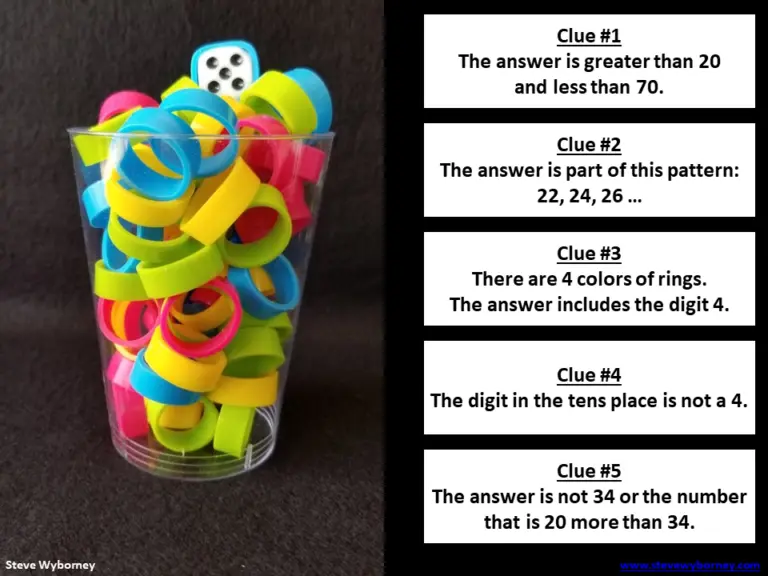
It Begins with a Single Image.
The experience begins here. A single image.
(The number of objects in the container has been very carefully counted ahead of time. In fact, the rule is that we triple count every object to be absolutely certain of the number.)
The question at the start of the Esti-Mystery is, “What is the number of objects in the container?”
With this simple image, students begin the estimation journey.

The Entire Class is Writing.
This step is very important.
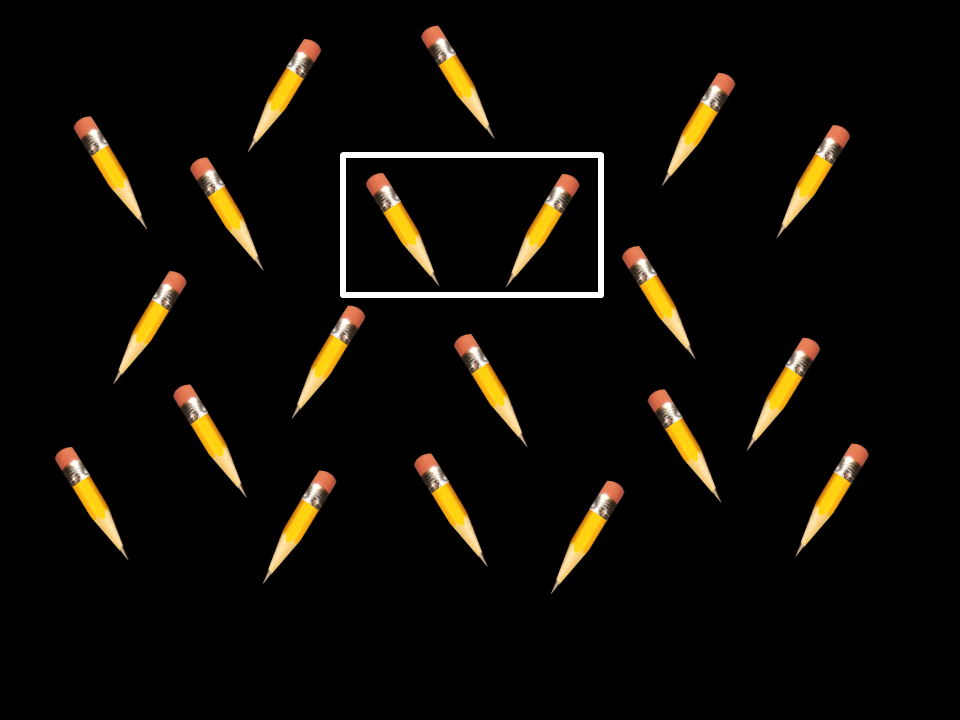
Before the video zooms in on the experience of two students, you can see a very powerful action taking place. Every student is writing down their estimate.
I cannot emphasize enough just how important this is. Every student should have something to write on. I strongly recommend that each student has their own copy of a hundreds chart.
Writing is a powerful act of thinking. In addition, the act of committing an estimate to paper is what allows the students to have rich conversations about what their estimate is – and why they chose that estimate.
It all begins with writing.
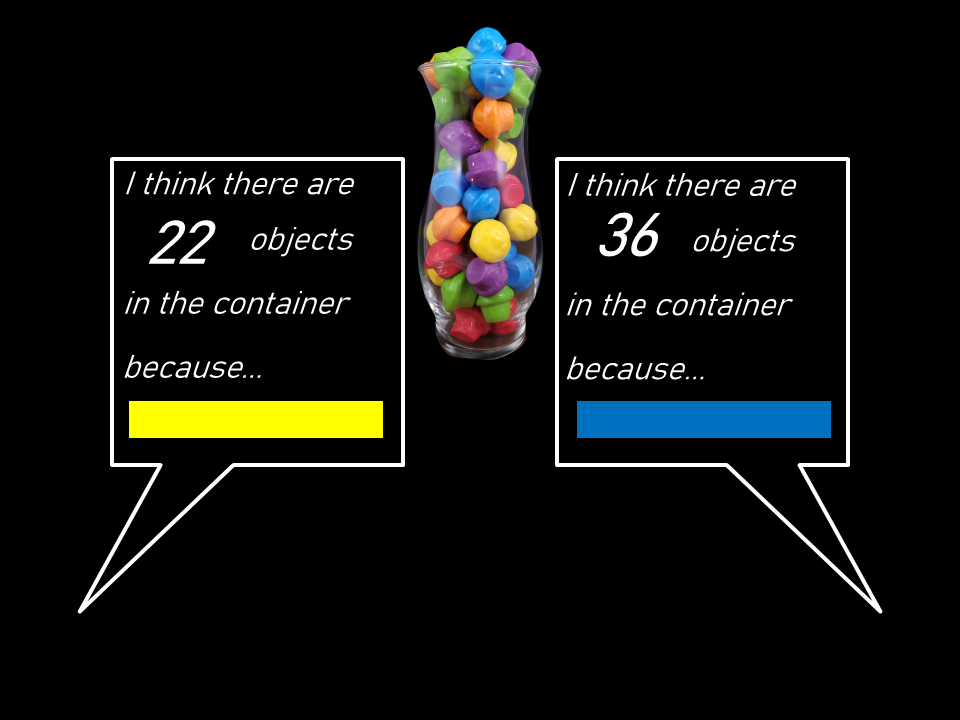
I think there are because…
This is my all-time favorite sentence frame / thinking launcher.
The key is to make sure students use the word “because” so that they travel into the territory of reasoning.
Insist that students use the word “because” and in the buzz of your classroom listen for that word.
“I think there are 22 objects because…”
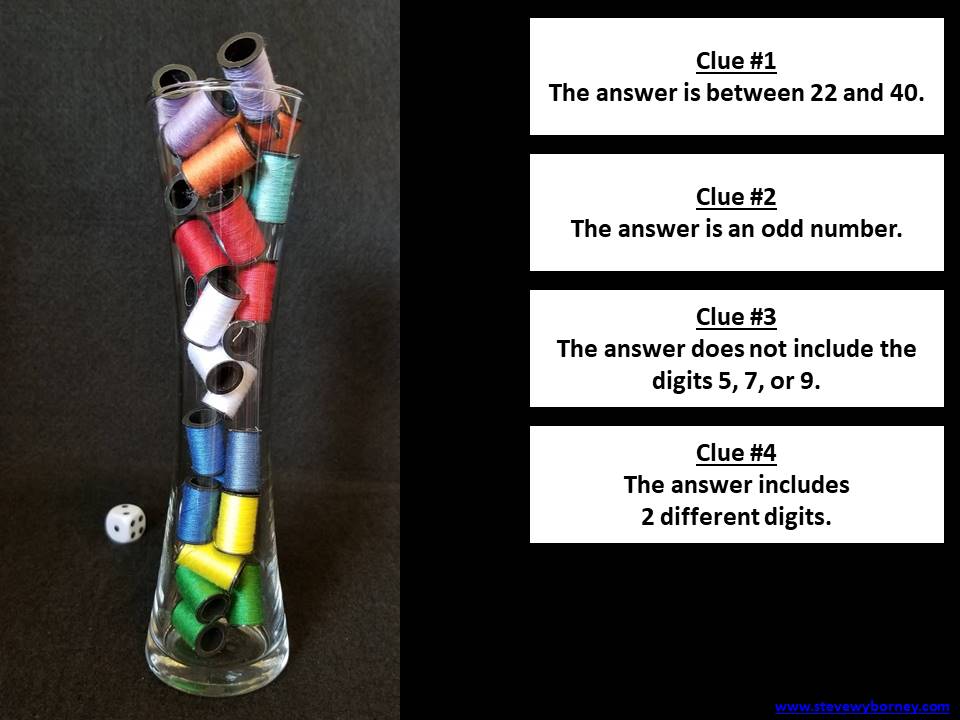
Students know there will be clues – and that the clues will not eliminate all of the answer choices.
At the end of the Esti-Mystery, there will be two (sometimes three) remaining answer choices.
The clues do not narrow it down to just one number. If there was just one number at the end, there would be no need for estimation at the end, no need for thinking, no need for discussion – and there would be no need for the reveal at the end.
By design, there are two (sometimes three) choices left at the end. The final question is which of those remaining numbers is the most reasonable.

So Much is Happening in This Moment

“The student considers the clue, thinks about their original estimate, sees the image again with new insight, can return to their reasoning, has heard the reasoning of someone else, and has an opportunity to iterate their own thinking.”
“In addition, the student has an opportunity to annotate.”
“And then, with all of this information in mind, has the opportunity to return to estimation again.”
“This entire process repeats every time a clue appears.”
Eventually – Selecting the Final Estimate
After repeating this process with every clue, the number of possible answers will be narrowed to two (sometimes three) choices.
From those choices, the student will estimate one final time, deciding which of those numbers is the most reasonable.
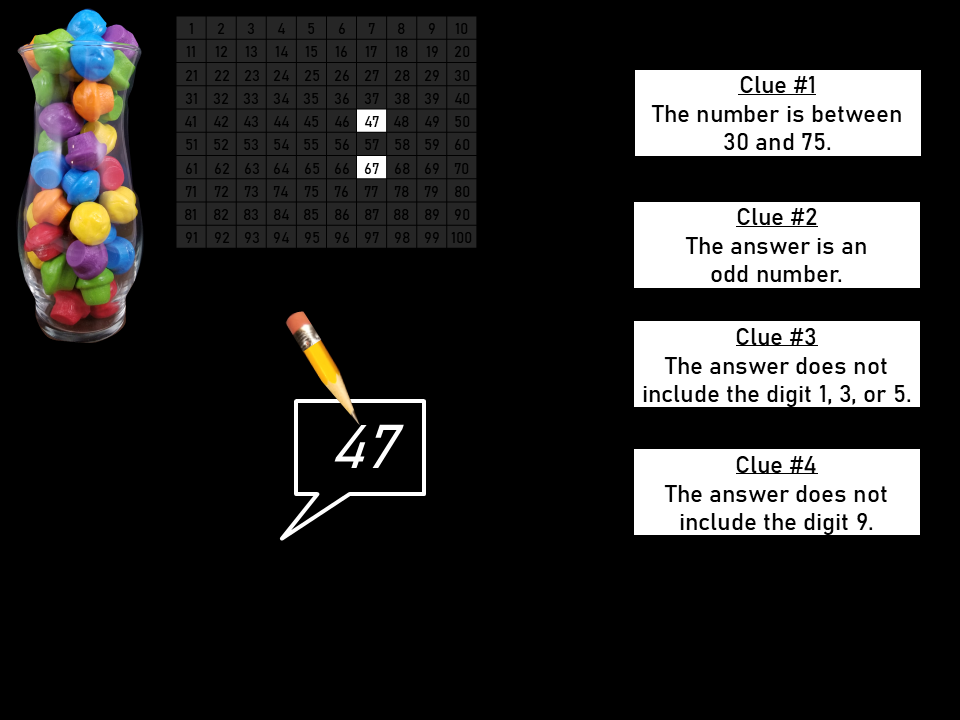
As with every other clue, the student will think about which of the remaining estimates is the most reasonable, will write it down, and will prepare to explain their reasoning to someone else.
The Reasoning – Before the Reveal
With The Reveal just moments away, each student will explain what their final estimate is and why they chose that number.
The reasoning – which is what you hear after “because” – is the richest part of the Esti-Mystery.
Then when conversations wrap up, it is time for The Reveal!

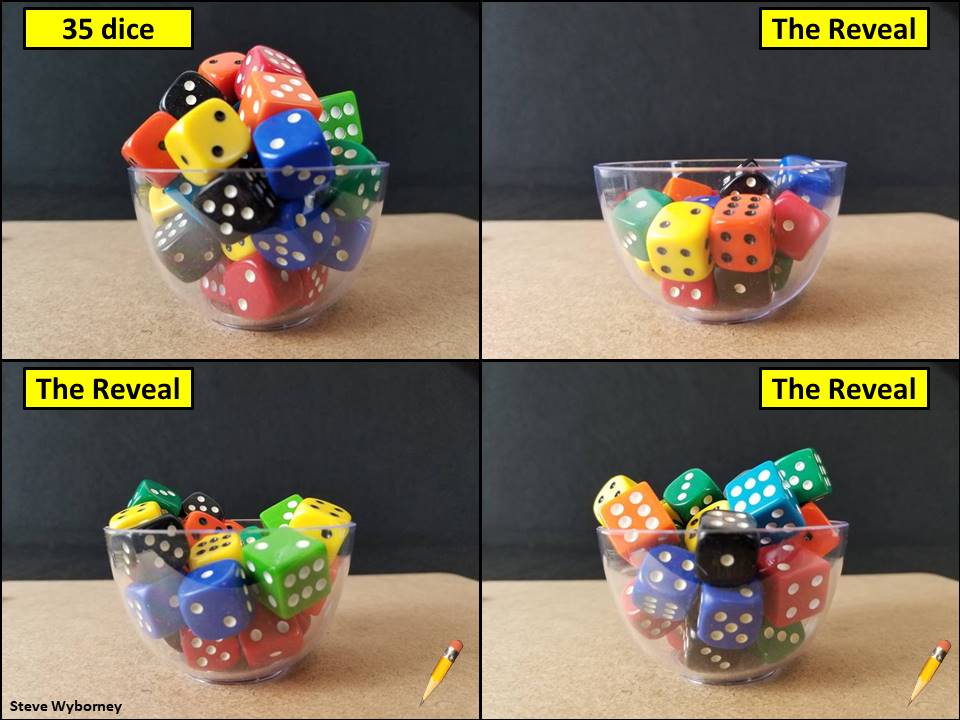
The Reveal
There are two distinct possibilities at this moment.
- Students’ estimates will match the actual number in The Reveal. They will celebrate, often with cheers. They may also ask for another Esti-Mystery.
- The other possibility is that a student’s estimate will not match the actual number in the reveal. That student may be surprised at the number they see.

What if the student’s estimate is not correct?
While students typically arrive at the correct number, it is common for some (or all) of a class to sometimes arrive at the other number – the one that is not correct. I have 3 tips to share.
- You can rest assured that the number in the reveal is the actual number of objects in the container. Our rule is to triple count everything to make certain that the number is exactly correct. Even so, students may be surprised at the number.
This is not a bad thing. In fact, it’s a really good opportunity for students to grow their estimation skills and their number sense. It’s a good opportunity for a student to learn about their own tendency as an estimator – and to add to their ability. - Ask the student if their estimate is lower than the actual number, or if it is higher than the actual number.
In almost every single case where a student’s estimate is different than The Reveal, the student estimate is lower than the actual number.
You’ll know this is the case if a student is surprised at how many objects are in the container – because their answer is so much lower.
I’ve had classes reach out to me because they are surprised the actual number in the container is so much higher than they expected.
By contrast, I’ve never had a class reach out to me because they were surprised that the actual number was so much lower than they expected. - When a student realizes that they have a tendency to estimate lower than the actual number, they are growing their self-understanding of their number sense – and that is powerful.
Many students – and adults – tend to estimate about 1/3 lower than the actual number. For example, if there are 60 objects in a container, someone might estimate that it is about 40. Listen carefully in your classroom. Among the cheering you may also see some students who are surprised at the number – and who have a really good opportunity to develop their number sense.
The Ten Ideas At The End of the Video

One thing that is amazing about Esti-Mysteries is that this list isn’t comprehensive. There are so many other elements of thinking that are happening during an Esti-Mystery.
And that doesn’t even include all of the math content that students are working with in addition to these acts of thinking.
In addition to all of that, the students are having a shared classroom experience which can further develop one of the most important aspects of any classroom: Community.
Esti-Mysteries can be a truly rich and rewarding shared experience.
Part 3: Tips and Resources
Try an Esti-Mystery Yourself
I always recommend previewing any Esti-Mystery – and any other type of educational content – before showing to students.
This not only lets you see the content, but it allows you to see rich opportunities particularly with the content of the clues. It also lets you anticipate the pacing of the clues.
However, there is one more benefit to previewing the Esti-Mystery: You can experience it yourself.
Whenever you preview an Esti-Mystery, do not jump directly to the answer under the Reveal.
Instead travel through it as an estimator. Experience it just as your students will.
- Look at the image. Think about what number that might be. Write it down. I recommend using a hundreds chart. Circle your answer. Don’t just think it – but actually mark your estimate just like your students will.
- Because you are previewing it on your own, you won’t have a chance to explain your reasoning to someone else – but remember that the conversation will be a very important part for your students. Of course, if you are previewing it with someone nearby, perhaps another colleague, then definitely take the time to explain your reasoning.
- After each clue, cross out the numbers that are eliminated by that clue. If your estimate is not eliminated, you can choose to keep it the same. If your estimate is eliminated by a clue, then select another estimate before continuing. Do this after each clue.
- After the final clue you will see two (sometimes three) numbers remaining. Select your final estimate before you preview the reveal. If you are correct, then celebrate. If not, take a moment to think about if your answer is lower than the actual number.
- Now you are fully prepared to share the Esti-Mystery with your class.
One Tip I Always Recommend
This is worth mentioning again: Give your students a hundreds charts to write on.
I always recommend this.
Not only will this provide your students with a chart to circle their estimate on, but it will allow them to fully engage with every clue.
If the clue says to cross off the odd numbers, students can do that on their chart.
If it says the answer is greater than 20 and less than 85, they can mark that on their chart.
The chart will also be the launchpad for conversation.
You may actually see students pointing to the picture – then pointing to their chart – then pointing back to their picture – and then to their chart again.
Providing students with a hundreds chart is providing them with a rich opportunity to think.
One Final Advanced Tip
I usually reserve this tip for classes that are very surprised by the numbers in the container, but it is actually a great tip for everyone.
Let students create their own Esti-Mysteries.
As someone who has created hundreds of Esti-Mysteries, I can tell you that it is a lot of work and is also a very rich thinking experience.
Students who create Esti-Mysteries will see much more clearly how many objects fit into a container. More importantly, they will combine and connect mathematical clues and ideas in ways that would not otherwise have been possible.
Creating Esti-Mysteries is a very rich experience.
If You Ever Want to Learn More
In the early years of creating Esti-Mysteries, I had so many people contact me asking if I could create Esti-Mysteries with certain clues, or with certain math concepts, or at certain grade levels that I finally wrote an online course on how to create Esti-Msyteries.
If you ever want to learn more, feel free to take a look at The Esti-Mystery Creator Course where you’ll find everything you need to learn how to create your own.
In the meantime, I’ve written a lot of Esti-Mysteries that you can easily download and use. See the full list below. I’ll be adding more to it this year.
November 2018: Esti-Mysteries: Estimation Meets Math Mysteries

September 2019: 51 Esti-Mysteries

February 2019: 20 Days of Number Sense and Rich Math Talk
November 2020: During Distance Learning
New Esti-Mysteries and Number Sense Resources Every Day for the Rest of the School Year
I created so many resources that I needed to write 3 more posts to contain all of them:
January 2021
Part 2: New Esti-Mysteries and Number Sense Resources Every Day for the Rest of the School Year
March 2021
Part 3: New Esti-Mysteries and Number Sense Resources Every Day for the Rest of the School Year

April 2021
Part 4: New Esti-Mysteries and Number Sense Resources Every Day for the Rest of the School Year

November 2021: 150 New Esti-Mysteries
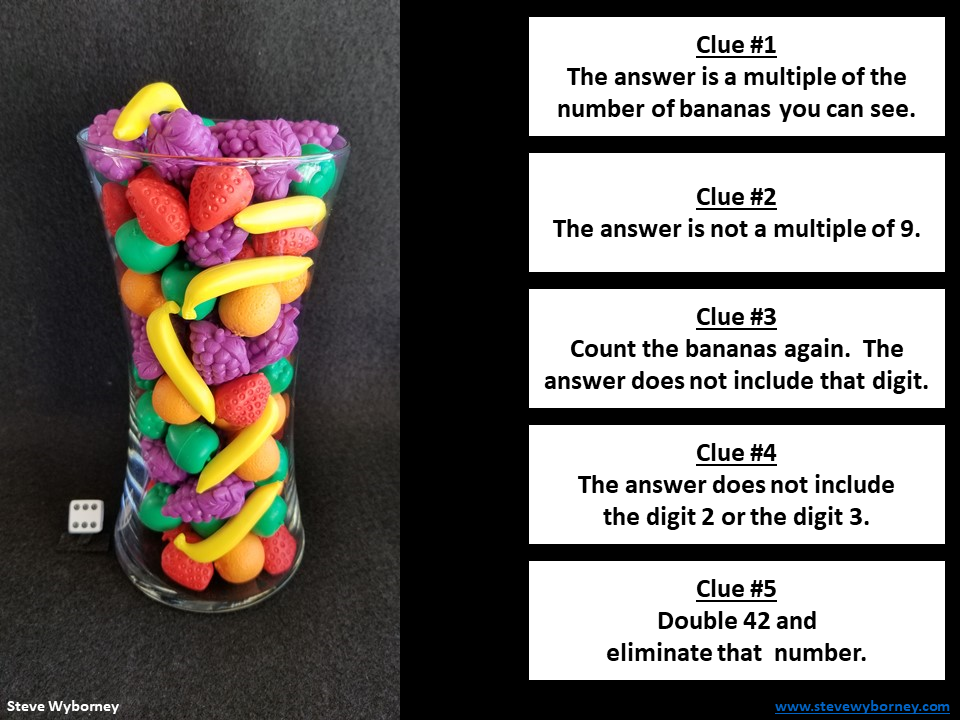
October 2022: 170 Esti-Mysteries
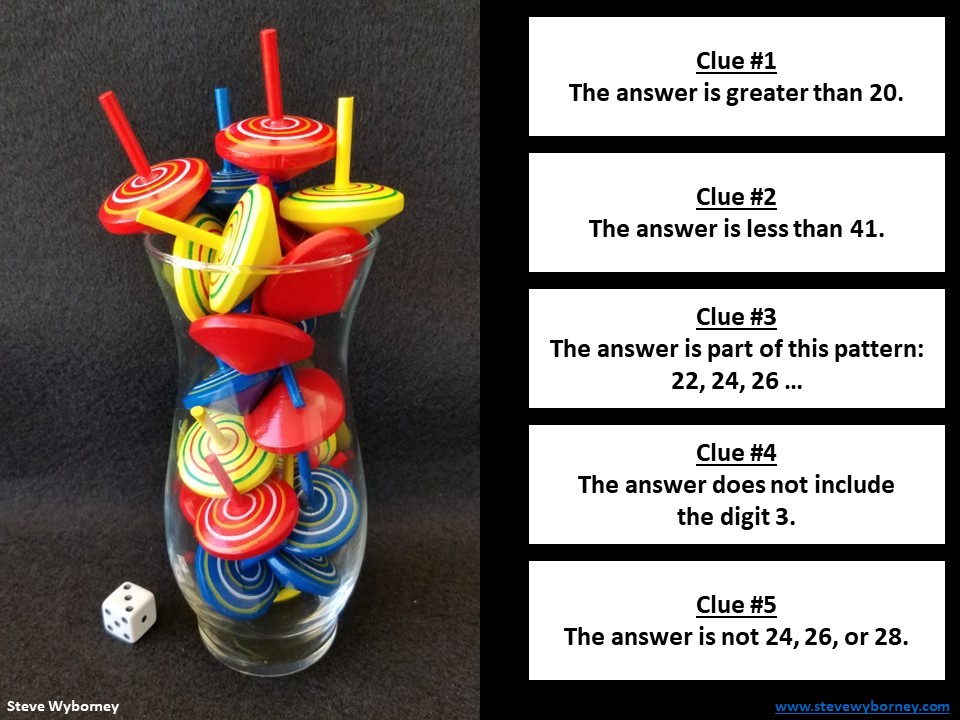
October 2023: 100 New Esti-Mysteries
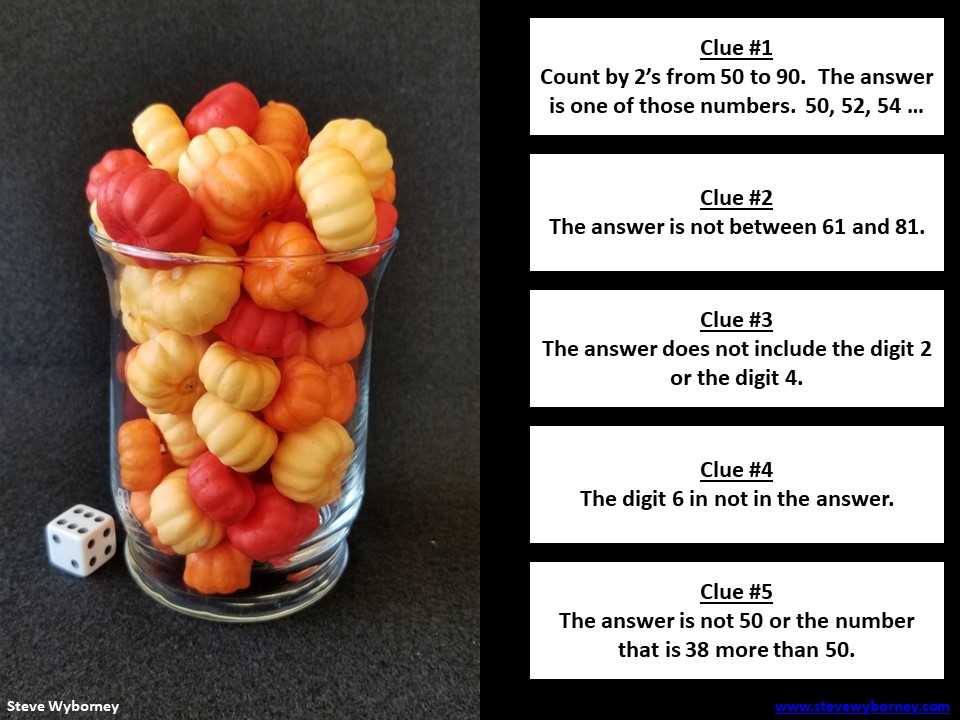
October 2024: 110 New Esti-Mysteries


Leave a Reply